Microbiology

Microbiology

Allissa Van Steenis

Allissa Van Steenis

Ashley Stengel

Ashley Stengel

Alice Naftaly

Alice Naftaly

Crystal Qualls

Crystal Qualls

A close-up of a chinook salmon at a hatchery in washington.

Salmon face hidden threat from changing diets, new study finds

By Hannah Ashton

Researchers in the College of Science, including faculty member Chris Suffridge and graduate student Kelly Shannon, have contributed to a multi-institution research paper revealing a hidden threat to West Coast salmon.

The research, led by NOAA Fisheries and shared on their website, brought together 37 co-authors across federal and state agencies — including the Oregon Department of Fish and Wildlife — universities and fisheries programs, reflecting an impressive level of collaboration to address an emerging ecological crisis. The team included oceanographers, fish nutritionists, hatchery staff and field biologists from around the U.S.

The findings show that when salmon feed heavily on northern anchovy, now increasingly dominant in the California current ecosystem, they risk developing severe thiamine (vitamin B1) deficiencies that can lead to high mortality rates in their offspring.

“This study represents the power of transdisciplinary and interagency collaborations to investigate complex emerging ecological problems,” Suffridge said.

Among those involved was Aimee Reed, who directs the Oregon Department of Fish and Wildlife Fish Health Services, a diagnostic laboratory servicing Oregon’s 34 public fish hatcheries as well as private aquaculture operations. The laboratory is part of the Department of Microbiology and located on the 5th floor of Nash Hall.

Published in the Proceedings of the National Academy of Sciences, the study connects recent shifts in the ocean food web to widespread thiamine deficiency in salmon populations. The researchers concluded that the deficiency likely killed as many as half of newly hatched fry of endangered winter-run Chinook Salmon in the Sacramento River in 2020 and 2021.

These thiamine-deficiency effects compound existing stress on salmon, including habitat loss and reduced water flow, pushing several runs towards commercial closures that have persisted for three years. The study underlines the urgency of integrated strategies addressing foraging fish dynamics, thiamine monitoring and hatchery supplementation to bolster salmon recovery.

“By bringing together scientists from universities, government and state agencies, this study has moved scientists closer to illuminating the root causes of thiamin deficiency in engaged populations of California salmon,” Shannon said.

Chinook salmon jumps through a grate.

A Chinook Salmon jumps at a hatchery in Issaquah, Washington. Fish health experts found that injecting adult female salmon with thiamine as they returned to hatcheries helped produce healthy offspring.

Ella Bailey wearing gloves and a mask, working with a teeth model, in a dental simulation lab at the OHSU Summit Program.

Ella Bailey, Class of ’25: BioHealth sciences major trains to be a dentist

By Kaitlyn Hornbuckle

After growing up in Fairbanks, Alaska, Ella Bailey answered a calling that made others smile: training to be a dentist. Thanks to the Western Undergraduate Exchange (WUE) scholarship, she developed a sweet tooth for Oregon State University.

With intensive training, job shadow opportunities and lifelong connections, her dreams were becoming a reality. But after her mother received a breast cancer diagnosis, Bailey wanted to drop out.

“Seeing your mom sick is really hard. I was supposed to come back to Oregon for training and work, but I didn’t end up coming. I was going to drop out and take time off, but my mom said I can’t, I have to go to school,” she said.

With her mother’s encouragement, she didn’t let anything stop her from learning how to be a dentist. She kept going. She built a support network and gained volunteer field experience during her time at Oregon State. And it was worth it.

Bailey is ready to graduate this spring with a bachelor’s degree in biohealth sciences. Over the next 10 years, she plans to complete dental school, own her own dental office and set up free volunteer dental clinics in Alaska.

“Crazy things happen to you in life and you just have to push through because you have no control over it. But after all of that, my mom is okay,” she said. “Now, my mom advocates for women’s health and goes to a conference in Washington D.C every year.”

Connecting with people and practices

Bailey loves challenging the status quo and looks up to her family as her strongest role models. Her grandmother Lisa was one of the first female forest firefighters in Alaska before becoming a middle school English teacher. Bailey’s mother served as a firefighter too.

Bailey was the first to break the generational firefighting chain, making her mark as a woman in science. As a child, she always felt comfortable at the dentist. After seeing how oral health was often overlooked and not accessible to everyone, she wanted to make a difference.

To be successful, Bailey needed a strong support system — and she found that at Oregon State. One of the first people she met became her roommate for three years and invited her to fun Thanksgiving dinners. Her roommate knew exactly what she wanted to do for a career and made it happen as a middle school English teacher, inspiring Bailey to not be afraid to reach for her goals, even if they’re difficult.

Ella Bailey smiles and celebrates with a group of women in colorful dresses.

Bailey (colorful dress, center left) helped plan and run Black Women’s Brunch in Corvallis to build a community.

While taking each stepping stone towards her science degree, Oregon State quickly became Bailey’s second home. Amid the rush of the academic year, one of her professors stood out. Her favorite course is Advanced Human Anatomy and Physiology taught by Integrative Biology Professor Devon Quick.

“I think she's one of the best professors that I've ever had,” she said. “She's very reasonable, open to questions, accommodating and approachable as a professor. She makes you want to attend class, be there, and learn.”

Outside of school, one of Bailey’s favorite outcomes in dentistry is making someone’s day a better one. Once a week, she shadows Dr. Martin Lindner and Dr. Charles Eric Jones at the Timberhill Dental office in Corvallis. One day, an older patient checked in to her appointment and the dentist asked if a student could observe.

“When I came in, she loved me,” Bailey said. “The patient said, “Oh my gosh, I love seeing women in science!” And she was so sweet. She told me that when she was my age, women were not allowed in science.”

If she’s not looking at teeth, Bailey is working in the Lonnie B. Harris Black Cultural Center and participating in an academic club for women called the Society of Scholarly Systems, where they host a variety of volunteer service projects. By collecting supplies and handing them out to the homeless population in Eugene, she found a way to make a difference outside of work and school.

“Everyone's path looks different. Do not judge your path compared to people around you."

Wanting to continue building her professional skills in Alaska, Bailey loves to visit her family and work at the same time. As an assistant at an orthodontist office, she started as a sterilization tech, making sure all of the spaces were clean.

Before long, she began assisting with orthodontic appointments, such as removing braces, holding suction tubes, taking impressions for retainers, and taking photos and x-rays of patient's’ teeth.

“The reason I even got the opportunity to work in orthodontics and became really interested in the dental field is because of the family who owns the office,” she said. Dr. Wentz and his wife Natalie Wentz became important mentors for Bailey. “Because I worked at that office, I was introduced to a number of orthodontists who have all been amazing to work with and learn from.”

Making people smile

Every time she returns to Oregon, Bailey wants to try something new. Inside an RV converted into a mobile dental clinic, she is one of several volunteers that offer free dental services. Anyone can sign up for a slot, and Spanish-to-English translators are available if needed. “It’s very eye-opening because they are really appreciative of us doing extractions or just kind of putting a Band-Aid on where we can,” she said.

Managing oral health can be expensive. Not everyone has a toothbrush or knows how to take care of their teeth, making hygiene difficult for some. People with diabetes are more prone to cavities, and poor oral hygiene can increase blood pressure.

“The first time I volunteered, I was assisting by holding the suction tube and handing instruments,” Bailey said. “This one patient had something that really bothered her and the dentist fixed and extracted her tooth. She turned to me and held my hand, and said, “Thank you so much.””

Ella Bailey wears orange Beaver gear with a group of friends inside the stadium (left) and outside the stadium (right).

Bailey celebrates beaver spirit with her friends at an Oregon State football game.

Throughout her adventures at Oregon State, professional mentors and heartwarming friends always offered a helping hand when she needed it most. When trying to find the right path for her, she found the support, both inside and outside the classroom.

“Everyone's path looks different. Do not judge your path compared to people around you. It’s easy to do that in college, especially in your twenties. Take pride in where you're at and what you're doing,” she said. “You deserve to be here.”

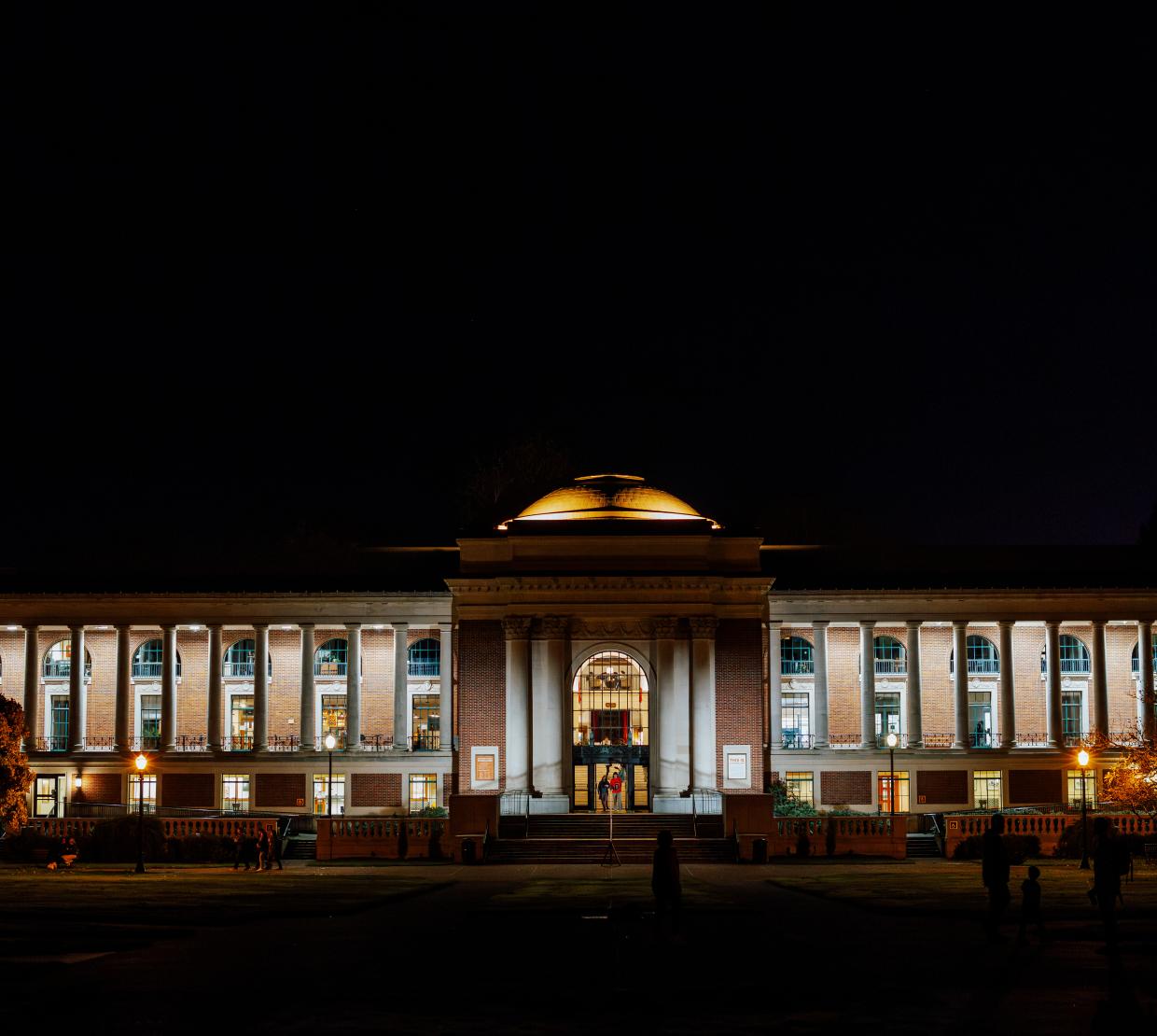
A nighttime image of campus.

College of Science graduate students earn prestigious awards in 2024-25

By College of Science

In the 2024-2025 academic year, graduate students in the College of Science received notable recognition through a variety of competitive fellowships, scholarships and professional development awards. These honors support students at critical stages of their graduate education, helping fund research, conference travel, tuition and other opportunities that contribute to academic and professional growth.

Here are the 2024-2025 recipients:

ARCS Foundation Awards

ARCS (Achievement Rewards for College Scientists) Foundation, Oregon Chapter seeks to advance science and technology in the United States by providing financial awards to academically outstanding students who are studying to complete Ph.D. degrees in science, engineering, mathematics, technology and medical research at Oregon Health & Science University, Oregon State University and the University of Oregon.

In 2024-25, the following College of Science graduate students received this award: Sarah Perkel (Biochemistry and Biophysics), Trent VanHawkins (Statistics) and Mallory Campbell (Physics).

Dissertation Completion Award

This award supports outstanding doctoral students who are in their final stages of their dissertations by offering an award to cover the cost of three graduate credits of tuition and mandatory fees for one academic term.

In 2024-25, the following College of Science graduate students received this award: Jordan McCaslin (Mathematics) and Lena Kinion (Biochemistry and Biophysics).

Fred W. Durbin and Helen E. Bette Pierce Durbin Endowment

Created by Fred and Helen “Bette” Durbin, this endowment supports graduate fellowships as determinedby the Dean. Fred received a bachelor’s in general science from OSU and Bette graduated with a bachelor’s in home economics (now the College of Health).

In 2024-25, two College of Science graduate students received this award: Ameh Benson Agi (Chemistry) and Jonathan Dutra (Biochemistry & Biophysics).

Grad Advantage Tuition Scholarship

This award is designed to provide tuition support to students who want to enroll in select graduate-level courses that directly support professional development activities associated with the graduate school’s OSU Grad Advantage framework.

In 2024-2025, one graduate student received this scholarship: Brooke Kaye (Statistics).

Graduate Dean’s Catalyst Fellowship

This highly competitive award is designed to support students conducting dissertation research that aligns with the 2024-2030 OSU Strategic Plan, Prosperity Widely Shared: The Oregon State Plan. The fellowship provides full graduate funding for one academic quarter, allowing the recipient time to make significant research progress that supports institutional goals.

In 2024-25, the following College of Science graduate students received this fellowship: Angelika Kurthen (Integrative Biology), Jalyn Deveraux (Integrative Biology) and Kaitlin McHugh (Integrative Biology).

Jesse A Hanson General Science Scholarship

The Jesse A Hanson General Science Scholarship is awarded to students who show high scholarship, potential for success, unimpeachable character and service to the university. Jesse Hanson was an OSU professor of poultry science from 1911-66.

In 2024-25, the following College of Science graduate students received this award: Joshua Byrnes (Statistics), Jessica Etter (Chemistry), Elena Gasiorowski (Integrative Biology) and Mikaela Lee (Microbiology).

Mark and Vicki Hehnen Veterans Science Scholarship

The Mark and Vicki Hehnen Veterans Science Scholarship supports science students who are veterans and provides financial support other than tuition. This award was established by Mark Hehnen (’78 Ph.D.).

In 2024-25, Rylan Chilcott (Chemistry) received this award.

NSF Graduate Research Fellowship

The National Science Foundation Graduate Research Fellowship Program (NSF GRFP) is a national award program of prestigious fellowships given each year to a select group of master’s and doctoral students in science and engineering fields in recognition of their academic and professional excellence. Students who receive the NSF GRFP benefit from a stipend, opportunities for international research and professional development, and the freedom to conduct their own research at any accredited U.S. institution of graduate education to which they are accepted.

In 2025-26, the following College of Science graduate students received this award: Russell Campbell (Integrative Biology), Dustin Campbell (Integrative Biology), Arina Martin (Integrative Biology), Ian Clifford (Integrative Biology), Jacob Wynne (Microbiology), Hannah Redhead (Physics).

The following students received an honorable mention: Delaney Chabot (Integrative Biology), Haley Hudson (Integrative Biology), Jacob Lessard (Integrative Biology), MJ Strike (Integrative Biology) andMeredith Anderson (Integrative Biology).

Oregon Flyfisher’s Club

The purpose of this award is to provide support for domestic or international graduate students pursuing a course of study involving one of the endemic wild stocks of fish within watersheds of the State of Oregon.

In 2024-25, Jesse Fritz (Integrative Biology) received this award.

Oregon Lottery Graduate Scholarship

Funds for this scholarship are provided through the Oregon State Lottery and are awarded to domestic or international graduate students enrolled in an advanced degree program at Oregon State. The scholarships are awarded on the basis of academic merit and financial need.

In 2024-25, the following College of Science graduate students received this award: Jeremy Baier (Physics), Jalyn Devereaux (Integrative Biology), Cheyenne Jarman (Integrative Biology), Chieh-His Kuan (Chemistry), Chung-Ping Lai (Mathematics), Roshell Lamug (Physics) and Jacob Lessard (Chemistry).

Professional Development Award

Many professional development opportunities exist beyond the university to help graduate students build core competencies and transferable skills. The OSU Office of Graduate Education invites students to apply for funding through the Professional Development Award to help cover costs for qualifying training, resources, and activities that contribute to professional skills development.

In 2024-25, the following College of Science graduate students received this award: Oluwaseun Adu (Integrative Biology), Jazlee Crowley (Integrative Biology) and Brenna Prevelige (Integrative Biology).

Provost’s Distinguished Graduate Fellowships and Scholarships

The purpose of the Provost’s Distinguished Fellowship and Scholarship program is to support programs in the recruitment of Oregon State’s most meritorious graduate students. As a Provost Fellow, the student is awarded a 9-month stipend, a matriculation fee waiver, a partial mandatory fee waiver each term, an academic year tuition scholarship and subsidized health insurance.

2024-2025 COS recipients: Timeyin Pajiah (Integrative Biology) and Emily Werner (Chemistry)

As a Provost Scholar, the student is awarded a sum, disbursed in three equal installments.

In 2024-25, the following College of Science graduate students received this award: Brandin Farris (Mathematics), Nadia Gonzalez (Biochemistry & Biophysics), Colin Grosvenor (Integrative Biology), Esther Julius (Chemistry), Daphne Maniatis (Physics), Isabella McColl (Chemistry), Zahrasadat Mirtalebi(Mathematics), Michael Perez Palapa (Mathematics), Hannah Redhead (Physics), Cort Vanzant (Integrative Biology), Lindsey Wingate (Chemistry) and Rong-Hui Yu (Statistics).

Scholarly Presentation Award

The Graduate School offers the Scholarly Presentation Award to provide graduate students with financial support to assist with certain costs associated with presenting their scholarly work at academic conferences and meetings.

In 2024-25, the following College of Science graduate students received this award: Luke Bobay (Integrative Biology), Austin Bosgraaf (Mathematics), Valerie Brewer (Integrative Biology), Laila Brubaker (Microbiology), Jun Cai (Integrative Biology), Jazlee Crowley (Integrative Biology), Evan Flint (Statistics), Jesse Fritz (Integrative Biology), Hua-Chien Hsu (Chemistry), Yu-An Huang (Chemistry), Jessica Karr (Integrative Biology), Angelika Kurthen (Integrative Biology), Logan Lancaster (Chemistry), Brittany Lasher (Biochemistry & Biophysics), Jiawei Liu (Chemistry), Cedar Mackaness (Integrative Biology), Arthur Mills (Mathematics), Emmanuel Musa (Chemistry), Olivia Noonan (Integrative Biology), Pakhin Pawornwitooon (Chemistry), Alyssa Semerdjian (Integrative Biology), Michael Sieler (Microbiology), Anjali Verma (Chemistry), Ankit Yadav (Chemistry) and Angelina Zuelow (Integrative Biology).

Science Graduate Fellowship

The Science Graduate Fellowship is to be used to support students enrolled in the College of Science with a preference for students in chemistry, biochemistry and the life sciences.

In 2024-25, one College of Science graduate student received this award: Emily Parker (Integrative Biology).

Wei Family Private Foundation Scholarship

The Wei Family Private Foundation, a non-profit organization, was established to honor the memory of Dr. (Mrs.) Chung Kwai Lui Wei and Mr. Hsin Hsu Wei. Its purpose is to award scholarships to graduate students with high academic credentials in science and math, with a preference for those who have lived in or are related to persons born in China.

In 2024-25, the following College of Science graduate students received this award: Ziang Jiangi(Chemistry), Mikaela Lee (Microbiology), Zejing Wang (Mathematics), Weiqi 'Grace' Li (Statistics), Xinyu 'Erica' Li (Statistics).
A man stands on a boat in a safety suit.

Microbiology graduate student awarded prestigious U.S. DOE educational award

By Hannah Ashton

Kelly Shannon, a Ph.D. student in the College of Science’s Department of Microbiology, was awarded a transformative educational award from the U.S. Department of Energy.

Shannon is one of 79 doctoral students from 56 universities and 29 states selected this year for the Office of Science Graduate Student Research (SCGSR) program. The program provides funding and access to DOE national laboratories, enabling them to conduct mission-critical research alongside leading scientists and develop into the next generation of science leaders.

Advised by microbiologist Rick Colwell and mentored by Chris Suffridge, Shannon will complete his dissertation research at Lawrence Livermore National Laboratory with microbial ecologist Xavier Mayali.

“This award is such an honor to receive. It means the absolute world to conduct research in this type of world-renowned facility, and with such amazing mentorship,” Shannon said. “I’m ecstatic to begin my project at Lawrence Livermore National Lab, and I hope that my research will make a difference in my field and in our ability to understand harmful algal blooms, which are so damaging to freshwater ecosystems and food webs.”

Two men in safety suits on a boat.

Kelly Shannon (left) and Chris Suffridge (right) filter water samples from Upper Klamath Lake, Oregon, as part of a project funded by the U.S. Fish and Wildlife Service.

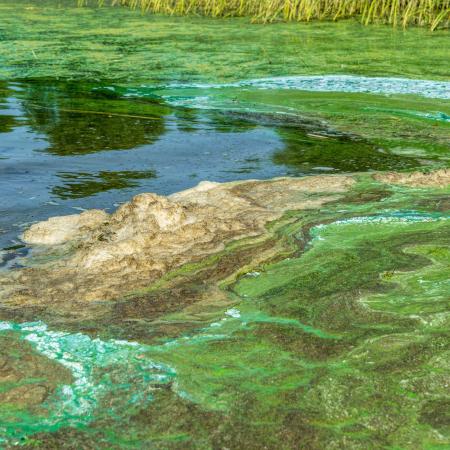
His research focuses on harmful algal blooms (HABs) caused by cyanobacteria, or blue-green algae, and how they acquire and share nitrogen, a key nutrient needed by all life. These freshwater HABs can produce toxins that threaten wildlife, drinking water and recreational areas worldwide.

Shannon is studying how cyanobacteria pull nitrogen from the atmosphere and make it available to other algae. Some cyanobacteria can “fix” atmospheric nitrogen, converting it into a form that can be used by living organisms. This process not only fuels their own growth but may also support other algal species in the bloom. Because HABs often consist of several interacting species, understanding how nitrogen moves between them may reveal new insights into how these blooms form and persist in nature.

He is also exploring the role of vitamin B1 and a natural toxin in this nutrient exchange. Vitamin B1, or thiamin, is essential for all microorganisms, including algae. He will test how the availability of thiamin, and a naturally occurring compound that interferes with thiamin use, affects nitrogen transfer between species. This could shed light on hidden chemical interactions that influence the development and toxicity of HABs.

Shannon earned both his bachelor's degree (2020) and master’s (2022) in microbiology from Oregon State. He is now pursuing his Ph.D. as a member of the Colwell Lab in the College of Earth, Ocean and Atmospheric Sciences.

In addition to the DOE award, Shannon was selected as Oregon’s young ambassador for the American Society for Microbiology in 2024.

Two men in water pants collect samples in a lake.

Kelly Shannon (left) and Chris Suffridge (right) collect water samples from Upper Klamath Lake, Oregon.

Woman uses gloves to sift through pile of wood chips in art exhibit

College of Science researchers highlight AI, clean energy and the environment through art at PRAx

By Hannah Ashton

Two College of Science faculty members — Maude David and Oksana Ostroverkhova — are helping bridge science and art in FutureFarmers: Silicon Forest, a thought-provoking new exhibition exploring the entangled relationship between ecology, technology and human agency.

On view through June 21, 2025, at the Patricia Valian Reser Center for the Creative Arts (PRAx), the exhibit blends scientific inquiry with artistic expression to invite deeper reflection on our digital future.

Created by the artist collective FutureFarmers, the exhibit invites the public to explore reciprocal relationships between natural ecosystems and technological infrastructures in the “Silicon Forest” — the nickname for Oregon’s high-tech manufacturing corridor. Visitors move through conceptual installations — data records, water samples, wood chips and more — that challenge assumptions about clean technology and offer a space for reflection on our increasingly digital world.

“I am not artistic myself. But art can touch people who can’t easily relate to a ‘nerdy’ scientist,” Ostroverkhova said. “If we can spread the deeper message and touch more people through art, that's beneficial.”

Artists' statement in front of Silicon Forest exhibit

Ostroverkhova’s research group works on low-cost, organic materials for optoelectronic applications, such as solar cells. Her contribution to the exhibit is part of a collaborative scientific effort with colleagues in OSU’s colleges of Forestry and Engineering. Together, they’re investigating fungi-derived pigments including xylindein, a highly durable pigment, used by artists for hundreds of years, as a promising possibility as a semiconductor material.

Xylindein, a pigment secreted by two types of wood-eating fungi, stains wood a blue-green color, which artists have used for centuries. The pigment is so stable that art made more than 500 years ago still retains the color. It has held up against prolonged exposure to heat, ultraviolet light and electrical stress.

“If something has sat on a church ceiling for 500 years and hasn’t degraded, I want to know why,” she said.

Twelve small vials containing differently colored pigment materials

Maude David, associate professor of microbiology, works at the intersection of computer science and microbiome research. She contributed ideas and reflections about artificial intelligence, energy consumption and data ethics. She sees the abstract, immersive nature of the exhibit as a powerful tool for contemplation.

“AI is needed and it’s useful. In fact, I use it for my research. But what is the cost for our children?” she said. “More than 10% of the energy consumption in Oregon is just for data centers.”

Her wish for visitors is simple: stop and think. From pondering data storage’s environmental footprint to engaging with poetic critiques of AI culture, each part of the exhibit encourages personal reflection.

“We are the last generation where some of us grew up without a phone. My daughter’s pretending to make phone calls at three years old,” she said. “AI is difficult to see but technology is in the background of a lot of things we do.”

Subscribe to Microbiology