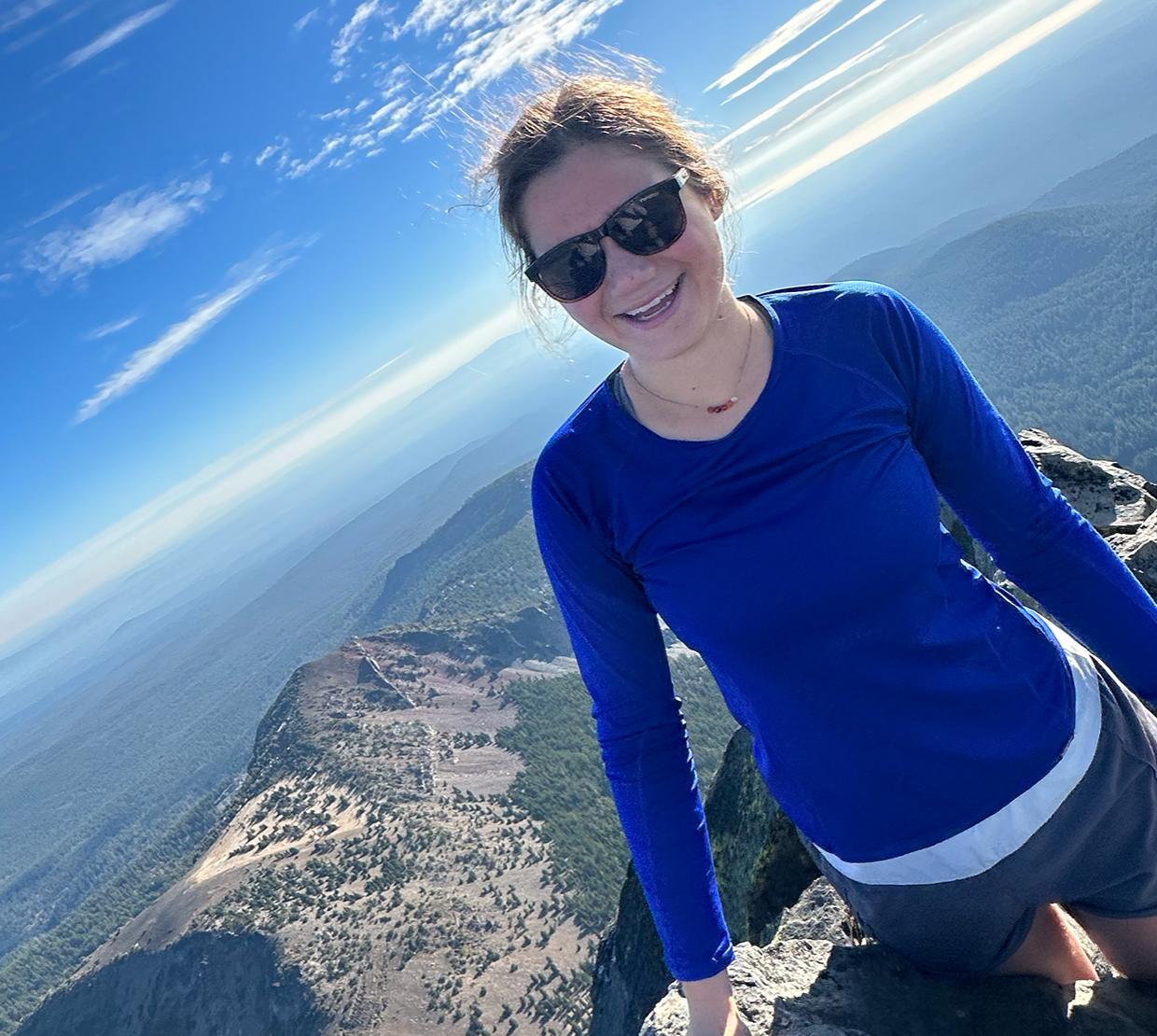
A woman in a blue shirt on top of a mountain.

Riley Whisler, Class of '26: Future doctor explores sports medicine, hospice care and building community

By Hannah Ashton

Riley Whisler poses for a photo on top of Mount Thielsen in southern Oregon.

One might think Oregon State senior Riley Whisler has more than 24 hours in a day. Her schedule reads like someone determined to use every precious second.

She’s an Honors microbiology major who plays violin in the Albany Symphony, a triathlete, a physics learning assistant and traveler who spent months speaking only Spanish with her host mother in Barcelona. She helps Parkinson's patients stay active through a program called Rock Steady Boxing, paints nails in a Fairbanks, Alaska, nursing home during the summer and supports hospice patients and their families through some of life’s most vulnerable moments. And in the midst of it all, she completed an honors thesis exploring her grandfather’s experience in the American Indian boarding school system through the unique lens of basketball.

Those experiences have given her a firsthand view of health in all its forms, shaping her growing interest in sports medicine and palliative care.

“I think death is a very heavy thing, but I find that I’m just a little bit more aware of gratitude in my daily life,” Whisler said. “I also think it’s shown me some of the gaps in our current healthcare system that we need to fill.”

As Whisler graduates and prepares to begin medical school through the University of Washington, her time at Oregon State laid the foundation for the type of physician she hopes to become.

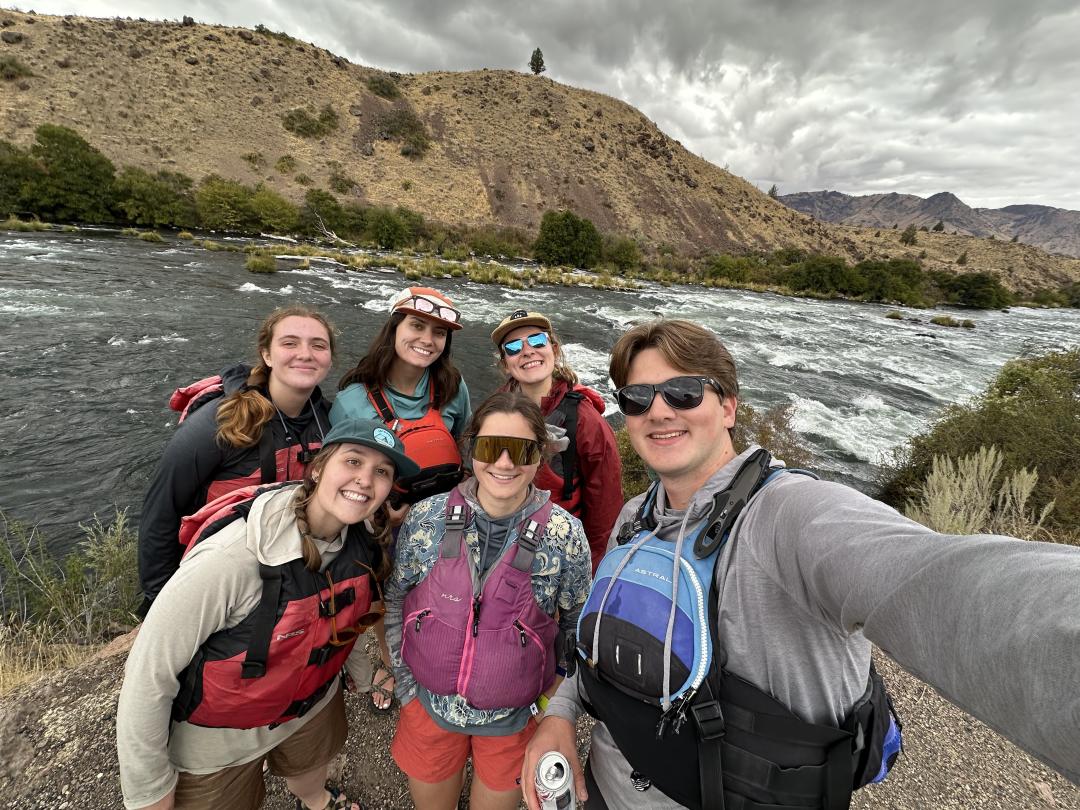
A group of people wearing life jackets pose for a photo while on a river rafting adventure.

Whisler and her roommates pose for a photo during an overnight float of the Deschutes River.

To do or not do laboratory work

Although she considers herself an indecisive person, Whisler knew right away that microbiology was the major for her. “It stood out to me because you have so many directions you can go with it,” she said.

Having opportunities allowed her to test different career paths before she even graduated. One option was laboratory research, something she tested out by working in a Department of Integrative Biology laboratory dissecting mussels.

“I realized the passion isn’t there,” Whisler said. “Love the ocean, she’s amazing, but I didn’t see myself working in a wet lab environment.”

Her mother, a physician, reminded her that if she was interested in medical school she needed to decide quickly.

By her sophomore year, Whisler shifted toward human health coursework like anatomy and physiology and immunology, finding herself increasingly drawn to medicine.

Volunteering her time and moving her body

Outside of classwork, Whisler started to fill her time with volunteering. One of her favorite programs is Rock Steady Boxing, a non-contact boxing program designed to help people with Parkinson’s Disease improve mobility and quality of life. The Mid-Willamette Family YMCA in Albany, hosts the program three times a week.

“It really focuses on exercises and training things that help with Parkinson’s symptoms specifically that you might not expect,” she said.

The first half of the class is either cardio, strength or skill training. The skill could be hand dexterity or even smelling, because losing your sense of smell is one of the earliest signs of Parkison’s Disease. The second half of the class is a boxing workout. Whisler either holds the focus mitts, gives instructions or mirrors exercises.

“We have a really good time and it’s a cool community they’ve built in Albany. That is one of my favorite volunteer activities,” she said. Her pre-med advisor in the College of Science was the one who introduced her to the program.

Much of her volunteer work is done with a hospice program in Fairbanks, during summer breaks. It started as a way to give back.

“I had a family member who went through hospice, and I was surprised at the level of support they offered and wanted to get involved and help something that supported our family so much,” she said.

Whisler provides another part of the patient care team offering comfort and companionship.

“I sit and we chat, we go over photo albums,” she said. “I planted a garden for somebody, which was really amazing. Actually, the patient passed and his wife offered me part of the garden harvest. I said of course I would take the lettuce that we grew together.”

Working with hospice patients has led Whisler to consider specializing in palliative care in medical school. However, she has another passion: sports medicine.
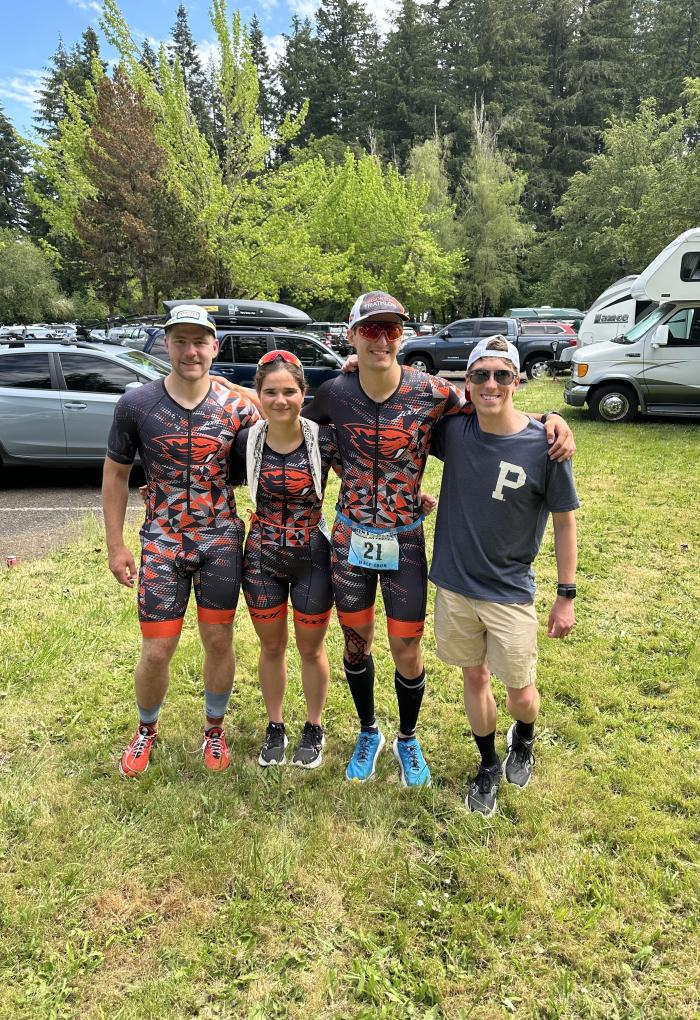
Four people in triathlon gear pose for a photo.

Whisler and other Oregon State Triathlon Club members pose for a photo after a race at The Best in the West Triathlon Festival.

How many sports does Whisler participate in? A lot. She grew up as a competitive swimmer and then mixed it up by trying cross country running and Nordic skiing.

Now, on Friday mornings, you might catch Whisler in a pool on campus, training for her next triathlon. She is part of the Oregon State Triathlon Club, made up of students, faculty, staff and affiliates of OSU.

The club is a way to train for, race or participate in triathlons and other multi-sports events. It is open to all abilities, including people learning to swim and those who have completed Iron Man competitions.

“I chose triathlon because it’s a fun mix of multiple sports. When you get tired of one, you can do another kind of thing. And I think the club environment is super, super positive,” she said. “I’ve found my type two fun people who I can drag out for ridiculously long mountain days.”

For the past 30 plus years, the club has hosted the annual Beaver Freezer Triathlon, one of Whisler's favorite days of the year. She’s the coordinator of the swim section so she’s on the pool deck making sure everything runs smoothly.

“It’s incredible how it’s a student run triathlon,” she said.

On Tuesday evenings her schedule involves a 20-minute drive to participate in the Albany String Orchestra. Her high school violin instructor was a member of the Fairbanks Symphony Orchestra and taught her how to play.

The group in Albany gives Whisler a new category of people to hang out with.

“I am the youngest person by a bit. Although we’ve had some recent younger additions, I’d say the medium age is like 55,” she said. “It’s a great group, halfway through everyone eats sweet treats they brought, it’s ideal.”

Study abroad and honors thesis work

Her academic life is just as busy. During winter and spring terms her junior year, she decided to study abroad in Barcelona. Her course load included 12 credits of Spanish, a class on the history of Barcelona and a course on aging societies.

“It was focused on how in the Western world the population is aging and it’s become a health care issue and also a social security and welfare issue,” she said. “The professor who taught it was big in Spanish politics and helped write a few of their laws on how they should run their welfare systems.”

Although Whisler took Spanish in high school, she wasn’t fluent prior to the trip. Her host mother didn’t speak any English which was difficult at first.

“We were driving in the taxi after she picked me up and I was dusting off my high school Spanish and I was like, ‘Oh, no.’ I could only speak in present tense for a week before Spanish classes started and I remembered all the different tenses,” she said.

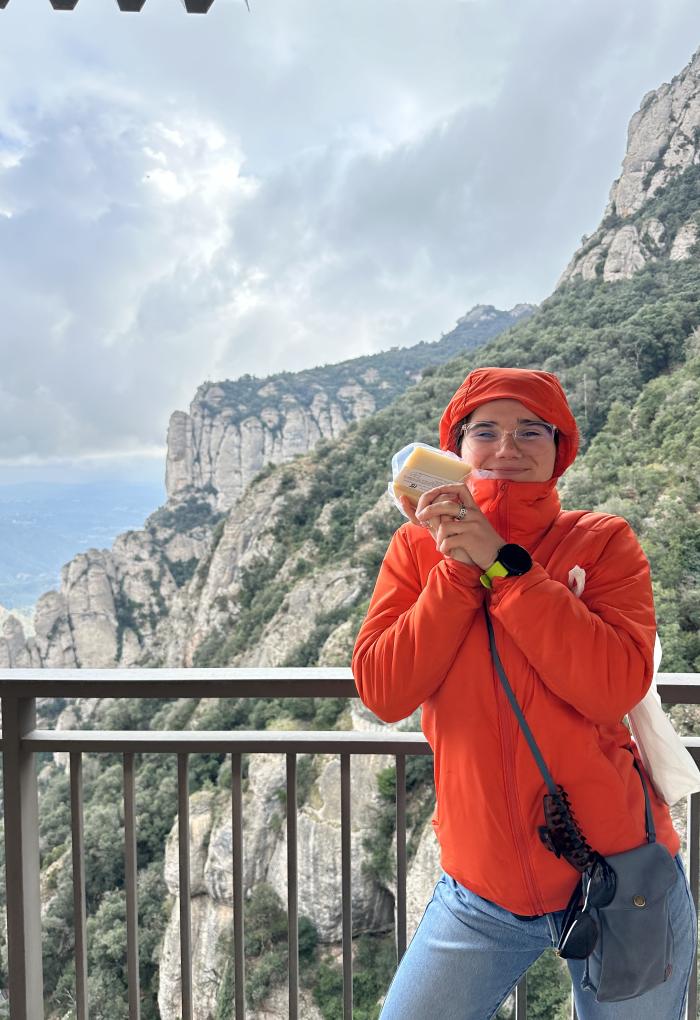
A woman in an orange jacket poses for a picture near a mountain holding a package of cheese.

Whisler holds a package of cheese at a monastery in the Montserrat mountain range in Spain.

After the course ended, she did a bit of traveling in London with friends and then spent a few weeks in Inverness, Scotland. In between sightseeing and hiking, she worked on her honors thesis.

Instead of focusing on a scientific project, she decided to mix it up and focus on her grandfather. She said the Honors College was supportive of her project and they appreciate it when students branch out and find what they are passionate about.

Her grandfather went through the American Indian boarding school system, one of the last generations to experience that level of school trauma.

The American Indian and Alaska Native boarding schools were established in the late 19th and 20th centuries to assimilate Indigenous children into Euro-American culture by removing them from their communities, prohibiting their native languages and forcing strict discipline.

Whisler's honors thesis focuses on how her grandfather's life interacted with basketball both in the boarding schools as a student and then when he moved on to teach in rural Alaska and work as a coach. He was responsible for bringing the sport to a couple of villages.

A future in medicine shaped by community

Creating communities is the underlying theme of Whisler’s undergraduate experience.

“I grew up with a family that emphasized how important community was and I think that has manifested in my life where I like to organize get-togethers and join groups,” she said. “I would say to an incoming student that the first club you try might not be your people and that’s okay. I had to give it some time and say yes to more things than you say no to.”

Every step has helped prepare her for the University of Washington WWAMI regional medical education program. The acronym stands for the five participating states: Washington, Wyoming, Alaska, Montana and Idaho. Students from these states can receive high-quality medical training while also paying in-state tuition and focusing on rural and primary care.

“I think bettering the human condition in general is maybe what the point of science should be."

She will get to stay in Alaska for the first 18 months to complete the foundational curriculum. Then she can do her rotations anywhere in the five-state region.

The human side of science will always be her driving interest.

“I think bettering the human condition in general is maybe what the point of science should be. I also find that I really enjoy social interaction, and I find that super fulfilling. Hence, I think a lot of my volunteer work has been where I’m interacting with people and learning about them,” she said. “I find myself really curious about other people and medicine is a way to get to know people and hopefully solve problems together.”

Whether she is in a pool training for triathlons, sitting with hospice patients or conversing with new people halfway around the world, she keeps returning to the same focus: understanding others and learning how to help.

In many ways, her time at Oregon State has been less about choosing one path and more about learning how to move comfortably among many.